 Auto Alpha Advisory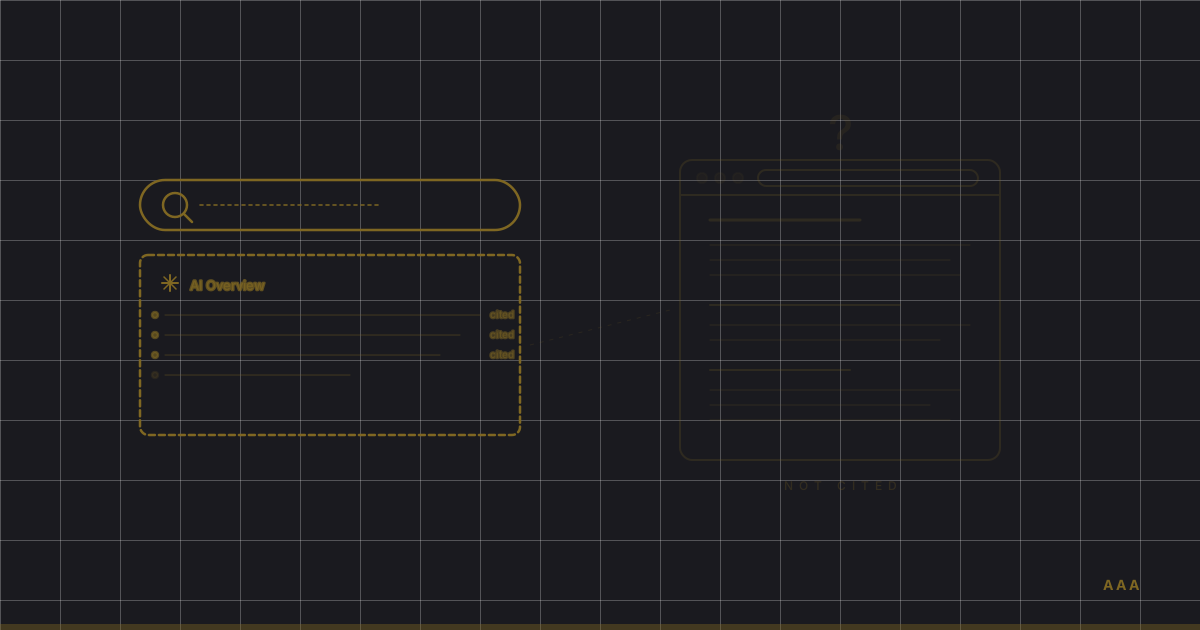
Something has changed in how people find businesses online, and most South African business owners haven't noticed yet.
Google AI Overviews — the AI-generated answers that appear above the traditional link list — now show up on a large and growing share of searches. Conductor's analysis of 21.9 million Google searches found 5.5 million returned an AI Overview, or 25.11%; other trackers report considerably higher, because they sample different query sets. Pick whichever number you like — a quarter to a majority is the honest range, and it is rising. When someone searches for "best panel beater near me" or "how much does a website cost in Cape Town", they increasingly get an AI-written answer at the top of the page. Your website might not appear in that answer at all.
As someone who runs automated website audits for mid-market South African businesses — and who's built 6 production AI products — I've seen this problem up close. Most business websites are structured for the old search model. The new one has different rules.
What is GEO and why should you care?
GEO stands for Generative Engine Optimisation. It's the practice of structuring your website content so that AI search engines — Google AI Overviews, ChatGPT, Perplexity, Microsoft Copilot — can find, understand, and cite it when answering user questions.
Traditional SEO optimised for the link list. GEO optimises for the AI-generated answer that appears above the link list. I wrote a detailed technical breakdown of GEO earlier — this post focuses on why it matters for your business right now. For the mechanics of how AI actually reads a page, the dual-reader thesis covers it in full.
Here's the hard number: searches that trigger AI Overviews now show a zero-click rate of 83%, against roughly 60% for searches without one (LLMrefs zero-click analysis). That means 8 out of 10 users get their answer directly inside the search interface without ever clicking through to a website.
If your content isn't part of that AI-generated answer, you're invisible to a growing share of your potential customers.
Does ranking on Google mean AI engines will cite you?
Not reliably, and the gap is wider than most business owners assume.
Semrush's AI Mode study — 5,000 queries and more than 150,000 unique citations, analysed July 2025 — found that only 35% of the URLs cited in Google's AI Mode also appear in Google's own organic top 10 for the same query. Roughly two-thirds of what AI Mode cites is not what Google ranks. The overlap varies sharply by engine: AI Overviews sit at 67% URL overlap with the top 10, Perplexity at 82%, ChatGPT below 40%. In practical terms: you could rank #1 on Google for your target keyword and still not appear in the AI answer that sits above your listing. The factors that earned you that ranking — backlinks, domain authority, keyword density — aren't the same factors that decide whether an AI engine cites your content.
What AI engines look for instead is structured data, direct answers, cited sources, and author credentials. If your website doesn't have these, your traditional ranking won't save you.
What makes content visible to AI engines?
AI engines don't just scan for keywords. They look for content they can confidently cite — content with clear answers, verifiable claims, and structured information.
There's also a technical floor most owners don't know about. Vercel and MERJ, measuring AI-crawler traffic across their network in late 2024, put it plainly: “none of the major AI crawlers currently render JavaScript.” If your content only exists after JavaScript runs in a browser, it doesn't exist to the machines writing the answers.
Princeton and Georgia Tech research on GEO found that the top optimisation methods — citing sources, adding statistics, and including direct quotations — can improve AI visibility by 30-40% compared to unoptimised content.
Here's what that looks like in practice:
1. Answer questions directly. AI engines answer questions. If your website contains questions and direct answers in a parseable format — like an FAQ section — it's significantly more likely to be cited. Every page on your site that discusses a service should include 3-5 frequently asked questions with concise, direct answers.
2. Cite your sources. When you make a claim, back it up. "80% of AI projects fail" is an opinion. "More than 80% of AI projects fail — twice the rate of non-AI IT projects (RAND Corporation)" is a citable fact. AI engines strongly prefer verifiable claims because they need to trust the content they surface.
3. Include local context. When someone asks an AI engine "best web designer in Cape Town" or "how much does a website cost in South Africa", the engine looks for content with local markers. Mention your city, use ZAR pricing, reference South African regulations — these signals tell AI engines your content is relevant to local queries.
4. Structure content with search-query headings. Your H2 and H3 headings should match the way people phrase search queries. "What does a website redesign cost?" beats "Our Pricing". "How long does an AI implementation take?" beats "Timeline".
5. Demonstrate expertise. AI engines evaluate E-E-A-T — Experience, Expertise, Authoritativeness, Trustworthiness. Author credentials, specific examples from real work, and detailed knowledge signals all strengthen your content's citation likelihood. I wrote The AI Advantage partly to build this exact kind of authority signal.
The traffic shift is already happening
This isn't a theoretical future. Traffic from AI chatbots to retail websites grew 520% between 2024 and 2025 (Adobe, 2025). Meanwhile, 58.5% of US Google searches already ended without a click in 2024 (SparkToro/Datos) — and that number is higher for searches that trigger AI Overviews.
The businesses being cited in AI answers are capturing a new, high-intent traffic source. The ones that aren't are watching their visibility erode.
For South African businesses, there's actually a first-mover advantage here. Most local competitors haven't adapted to GEO yet. The businesses that structure their content now — while competitors are still optimising only for traditional search — will build citation authority that compounds over time.
What to do this week
You don't need to rebuild your website. Start with these three changes:
Add FAQ sections to your key pages. Your services page, your about page, your most important blog posts. Write 3-5 questions that your customers actually ask — in their words, not yours — and answer each one directly in 2-4 sentences.
Audit your headings. Go through your website and check: do your H2 headings match search queries? Replace vague headings like "Our Approach" with specific ones like "How an AI readiness audit works and what you get".
Add credential signals. Make sure your expertise is visible in the body of your content, not just buried in an "About" page. One natural credential mention per page — your qualifications, years of experience, specific projects you've completed.
These three changes take a few hours and can meaningfully improve your visibility in AI-generated search results.
See who's winning your industry's AI shortlist. We publish The SA AI Visibility Index — the measured share of AI answers each brand gets, per industry, updated each edition. If your vertical is covered, you can see the gap before you spend a cent closing it.
Frequently Asked Questions
What is GEO (Generative Engine Optimisation)?
GEO is the practice of structuring website content so that AI-powered search engines — Google AI Overviews, ChatGPT, Perplexity — can find and cite it when answering user questions. It's complementary to traditional SEO but uses different signals, focused on direct answers, cited statistics, and structured information.
How many Google searches now show AI Overviews?
Estimates vary widely and it's worth understanding why. Conductor measured 25.11% across 21.9 million Google searches (2026), while other trackers report figures above 60%. The trackers aren't contradicting each other so much as measuring different things — a keyword set weighted toward informational queries will show far more AI Overviews than one weighted toward navigational or transactional ones. Industry matters for the same reason: research-heavy B2B questions trigger them far more often than "buy this now" e-commerce queries. Treat any single headline percentage as a sample, not a constant, and check your own category rather than the average.
Will GEO replace SEO?
No. GEO and SEO are complementary — many of the same practices that improve AI visibility also improve traditional search rankings. The difference is in emphasis: GEO prioritises direct answers, cited sources, and structured data, while traditional SEO focuses more on keywords, backlinks, and domain authority. South African businesses should optimise for both.
How much does it cost to optimise a website for AI search in South Africa?
The structural changes described in this post — FAQ sections, heading restructuring, credential signals — can be done in a few hours by someone who knows what they're looking for. For a comprehensive website audit that includes GEO readiness assessment alongside security, performance, and accessibility checks, Auto Alpha Advisory offers a free nine-domain automated audit. Full website rebuilds with GEO optimisation built in range from R15,000 to R50,000 depending on scope — see our services for details.
Can small businesses compete with large companies in AI search results?
Yes — and this is one of the most encouraging aspects of GEO. AI engines prioritise content quality and specificity over domain authority. A Cape Town panel beater with a well-structured FAQ page answering specific customer questions can outperform a national chain's generic corporate site in AI-generated answers for local queries.
If your website's visibility in AI search is something you're thinking about, run a free audit to see where you stand today — and if you want that score tracked continuously instead of once, AIV measures it monthly across ChatGPT, Claude, Perplexity, and Gemini. Or book a discovery call — 30 minutes, no pitch, just an honest conversation about what's working and what isn't.