 Auto Alpha Advisory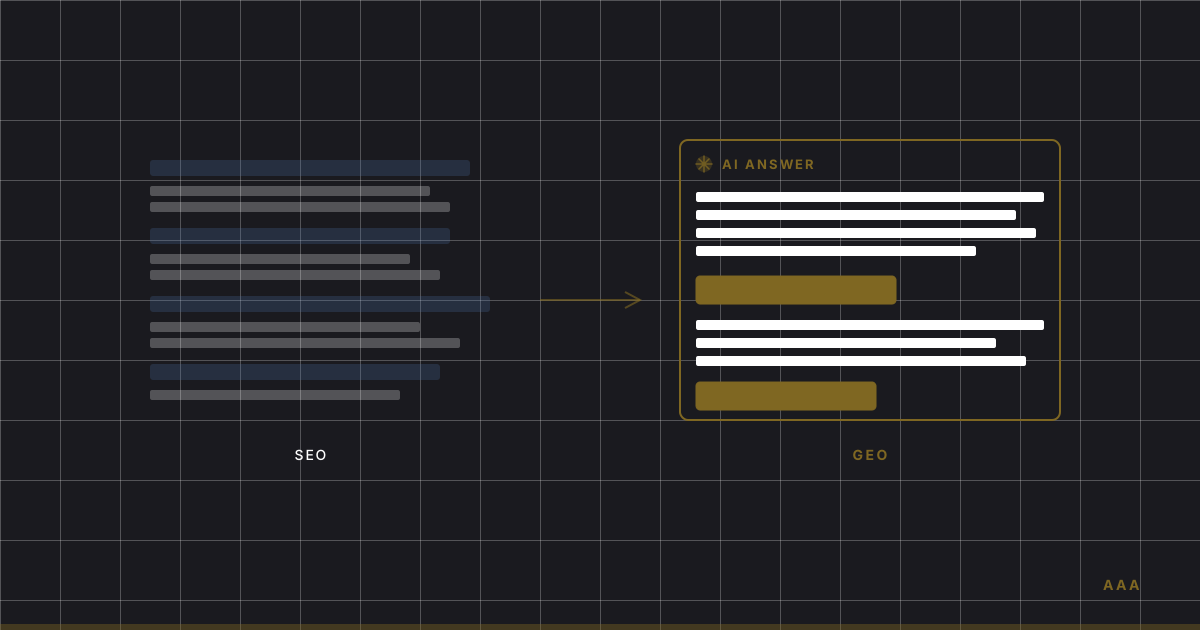
Your website might rank well on Google. It probably doesn't exist in AI search.
When someone asks ChatGPT "best financial advisor in Cape Town" or types "AI consulting South Africa" into Perplexity, the answer doesn't come from your Google ranking. It comes from structured data, author signals, and content that AI engines can parse and cite. Most South African business websites have none of this. Having spent years building both websites and AI systems — first as a CA(SA) at KPMG, then as someone who writes production code — I can tell you the gap between what AI engines need and what most sites provide is significant.
This gap has a name: GEO — Generative Engine Optimisation. The name comes from the Princeton study that coined it, in which Pranjal Aggarwal and colleagues demonstrated "that GEO can boost visibility by up to 40% in generative engine responses." And it's not a future problem. It's happening now. According to Conductor's analysis of 21.9 million Google searches, AI Overviews now trigger on 25% of all searches — up 92% in just six months. Organic click-through rates for those queries have dropped 61% (Seer Interactive). The underlying numbers are public: Conductor's 2026 AEO/GEO benchmarks report found 5.5 million of those 21.9 million searches produced an AI Overview — 25.11%, to be precise — and Seer's year-on-year tracking measured organic CTR falling from 1.41% to 0.64% on queries where an AI Overview appears. If your content isn't structured for AI citation, a growing share of potential customers will never see your business.
What is Generative Engine Optimisation?
GEO is the practice of structuring your website so that AI-powered search tools — ChatGPT, Perplexity, Google AI Overviews, Microsoft Copilot — can find, understand, and cite your content when answering questions.
Traditional SEO optimises for the ten blue links. GEO optimises for the AI-generated answer that appears above them. Our AI-visibility methodology exists to explain exactly that shift — why structure, not keywords, decides who gets cited.
The distinction matters because AI search doesn't rank pages — it cites sources. When Google's AI Overview answers a question, it pulls from a handful of websites and attributes them. Everyone else is invisible. There's no "page two." You're either cited or you're not.
This is fundamentally different from fighting for position #1. Seer Interactive's September 2025 CTR study tracked 3,119 search terms across 42 client organisations and 25.1 million organic impressions over a 15-month period, and found that brands cited in an AI Overview get 35% higher organic click-through than when they aren't cited (0.70% versus 0.52%). Seer is careful about what that does and doesn't prove: "We cannot definitively prove that citation causes higher CTRs, it's equally possible that brands with stronger authority and higher baseline CTRs are simply more likely to be cited by Google's AI." Either way, the correlation is strong enough to act on — being in the AI answer tracks with getting the click.
How AI search engines decide what to cite
AI engines don't just scrape your page and hope for the best. They evaluate specific signals to decide whether your content is trustworthy, relevant, and machine-readable. Here's what actually matters:
Structured data (JSON-LD). Treat this as hygiene, not strategy. Schema makes your business machine-parseable and it's cheap to get right, so do it — but it is not the lever the market sells it as. When I later measured 600+ real AI answers across three South African industries, the most-recommended estate agency in the country had no structured data at all, while the brand with the most schema ranked mid-table. Corroboration from sources the engines already trust, and genuine category authority, separated the winners. Schema didn't.
Be sceptical of the numbers circulating on this. The widely-quoted claim that schema makes a page several times more likely to appear in AI Overviews traces back to research about content freshness, not markup — it's been repeated so often it reads as established. The useful types are Organisation, Article, Author and LocalBusiness; if you're a professional services firm in South Africa, ProfessionalService schema with your location, services and credentials is worth having. FAQPage is not — Google's own documentation now carries the notice that "the FAQ rich result feature is no longer shown in Google Search results", effective 7 May 2026. The markup is still valid; it just earns no display, so it's worth omitting outside a genuine FAQ page. Visible Q&A content remains well worth writing.
FAQ content with clear Q&A structure. AI engines answer questions. If your website contains questions and direct answers in a parseable format — proper headings, concise responses — it's dramatically more likely to be cited. This isn't about adding FAQ schema alone. The content structure itself matters. Real questions that match what people actually search for, with direct answers in the first sentence.
Author attribution and E-E-A-T signals. Google and AI engines evaluate Experience, Expertise, Authoritativeness, and Trustworthiness. Put a name, a title and a real credential on every page — visibly, and in the structured data. But be honest about what the markup is doing: SE Ranking's study of 129,000 ChatGPT citations found that "pages with FAQ schema average 3.6 citations, while those without reach 4.2. This means that schema alone does not significantly increase ChatGPT citation likelihood." The credential works because a reader and an engine can both see who stands behind the claim, not because a JSON-LD block multiplies your odds.
Content freshness. This one does hold up. The same SE Ranking study found content updated in the past three months averages 6 citations versus 3.6 for outdated pages — refreshing existing articles quarterly with new statistics or sections roughly doubles the citation rate. If your website content hasn't been touched in a year, it's losing citation potential every month.
Content depth. Thin pages don't get cited. AI engines need enough substance to extract a meaningful answer. Aim for 300+ words per page at minimum, with 1,500–2,500 being the sweet spot for service pages and articles.
What most South African business websites get wrong
I built a free website audit tool that scores websites across nine domains, including GEO. After running audits on dozens of South African business websites, the pattern is consistent:
No structured data. Most SA business sites — especially those built on WordPress templates or basic Wix/Squarespace setups — have zero JSON-LD schema. No business type, no service descriptions, no author data. To an AI engine, the site is just a blob of text with no machine-readable context.
No FAQ content. Service pages list what the business does but don't answer the questions potential clients are actually asking. "How much does [service] cost in South Africa?" "What should I look for in a [provider]?" These are the queries AI engines answer — and the websites that structure their content around these questions get cited.
No author signals. Most sites don't identify who created the content. No author name, no credentials, no expertise indicators. AI engines evaluating E-E-A-T have nothing to work with.
No freshness signals. No published dates, no update dates, no datePublished or dateModified in structured data. The AI engine can't tell if the content was written yesterday or five years ago — so it defaults to fresher sources.
Blocking AI crawlers. Some sites inadvertently block AI crawlers through overly restrictive robots.txt configurations. If your robots.txt blocks Perplexity, ChatGPT, or Google's AI crawler, you've opted out of AI search entirely. The scale of what you'd be opting out of is measurable: Vercel's crawler study counted 569 million GPTBot fetches in a single month, and found that "none of the major AI crawlers currently render JavaScript" — so if your content only appears after client-side rendering, those crawlers see nothing either.
South Africa's internet penetration is at 79.6% with 51.7 million users (DataReportal 2026). The audience is there and increasingly using AI-powered search. The websites serving that audience are mostly not ready. Those figures come from DataReportal's Digital 2026: South Africa report — which also notes 13.3 million South Africans, 20.4% of the population, were still offline at the end of 2025. The addressable market keeps growing while most sites stand still.
How to check if your website is GEO-ready
The fastest way to find out is to run the free audit. It takes two to five minutes and scores your website across nine domains, including a dedicated GEO score. The GEO assessment checks twelve specific signals:
- Structured data presence and type (JSON-LD)
- FAQ schema implementation
- Author attribution (schema and meta tags)
- Content freshness signals (datePublished, dateModified)
- Heading hierarchy quality
- AI crawler access (robots.txt configuration)
- llms.txt presence
- Meta description quality and length
- Content depth (word count and substance)
- Language declaration
- Open Graph meta tags
- Sitemap discoverability
You'll get a branded PDF report by email with your score, specific findings, and recommendations for each domain. No login required. No sales call. Just the data.
For the industry-level view, the SA AI Visibility Index publishes who the four big assistants actually name per SA vertical — with the method and every prompt public, so you can see exactly what "visible" looks like in your category.
Practical steps to improve your GEO score
If you've run the audit and your GEO score needs work, here's what to prioritise — in order of impact:
1. Add JSON-LD structured data. At minimum, add a LocalBusiness or ProfessionalService schema to your homepage with your business name, description, location, services, and contact details. If you publish articles, add BlogPosting or Article schema with author, date, and publisher information. This is the highest-impact change you can make. Google's Search team explicitly recommended JSON-LD for AI-optimised content in May 2025. Google's own guidance for its AI experiences puts it plainly: "Structured data is useful for sharing information about your content in a machine-readable way that our systems consider" — with the caveat that everything in your markup must also be visible on the page.
2. Add FAQ sections to your key pages. Take your services page and add a "Frequently Asked Questions" section with five to seven real questions your clients ask. Format them as proper headings with direct answers. Make the questions match how people actually search — "How much does an AI readiness audit cost in South Africa?" not "Audit Pricing Information."
3. Add author information. Put a name, title, and brief credential on every piece of content. Include author schema in your structured data. If you're a CA(SA), an attorney, or a specialist — say so in the visible text and the schema.
4. Update your content regularly. Add datePublished and dateModified to your page schema. Update key pages at least quarterly. Fresh content with visible dates gets cited more.
5. Check your robots.txt. Make sure you're not blocking AI crawlers. The default should be permissive — unless you have a specific reason to block them, let AI engines access your content.
6. Write meta descriptions that work as summaries. AI engines use your meta description as context when deciding whether to cite you. Write it as a clear, substantive summary of the page — not keyword stuffing. Aim for 120–160 characters.
The cost of these changes ranges from zero (if you can edit your own site) to R5,000–R15,000 if you need a developer to implement schema markup and restructure content. Compared to the visibility you're losing every month in AI search, it's a straightforward investment.
GEO vs SEO: what stays the same and what changes
GEO doesn't replace SEO — it extends it. Most of the fundamentals are the same: good content, proper headings, fast load times, mobile responsiveness. What changes is the emphasis.
| Element | SEO impact | GEO impact |
|---|---|---|
| Structured data (JSON-LD) | High | Critical |
| FAQ content | Medium | Critical |
| Author credentials | Low | High |
| Content freshness | Medium | High |
| Internal linking | High | Medium |
| Page speed | High | Low |
| Keyword targeting | High | Medium |
| Meta descriptions | High | High |
The biggest shift: SEO rewards pages that match keywords. GEO rewards pages that answer questions with citable, structured, authoritative content. If your website does both, you win in both channels.
The first-mover advantage in South Africa
Most South African business websites are still optimised purely for traditional search — if they're optimised at all. Structured data adoption among SA mid-market businesses is low. FAQ schema is rare. Author attribution is almost non-existent.
This is an opportunity. The businesses that implement GEO fundamentals now will be the ones AI engines cite when potential clients ask questions about their industry. Once AI engines establish citation patterns, displacing an established source becomes harder. First movers build a compounding advantage.
The barrier to entry is also low. These aren't expensive, complex changes. They're structural improvements to your existing website that make it readable by both humans and machines. Most of the work is adding schema markup, restructuring content around questions, and keeping it fresh.
Frequently Asked Questions
What is Generative Engine Optimisation (GEO)?
GEO is the practice of structuring website content so that AI-powered search tools — ChatGPT, Perplexity, Google AI Overviews, Copilot — can find, understand, and cite it. Unlike traditional SEO which targets ranking position, GEO targets citation in AI-generated answers.
Does GEO replace SEO?
No. GEO extends SEO. The fundamentals — quality content, proper structure, fast loading, mobile responsiveness — still matter for both. GEO adds emphasis on structured data, FAQ content, author attribution, and content freshness. A website optimised for both channels gets the best results.
How do I check my website's GEO score?
The fastest way is to run the free website audit. It scores your site across nine domains including a dedicated GEO assessment that checks structured data, FAQ schema, author attribution, content freshness, and ten other AI-readiness signals. You'll receive a branded PDF report by email within a few minutes.
How much does it cost to optimise a website for GEO in South Africa?
Basic GEO improvements — adding JSON-LD schema, restructuring FAQ content, adding author signals — typically cost R5,000–R15,000 if you hire a developer. Some changes (updating content, adding FAQ sections) can be done by anyone who can edit their website. The Website Audit & Rebuild service covers full GEO implementation as part of a broader website overhaul.
Is GEO relevant for South African businesses specifically?
Yes. South Africa has 51.7 million internet users and growing AI search adoption. When South African consumers use ChatGPT or Google AI Overviews to find local services, the businesses that appear in those AI answers are the ones with structured, AI-readable websites. Most SA business sites aren't there yet — which means early movers have a real advantage.
If GEO is something you want to get right, start by running the free audit to see where you stand. Once you've fixed the structural issues, the AIV Index tells you whether it's working — monthly tracking of your citations across ChatGPT, Claude, Perplexity, and Gemini, not a one-time score. Or book a call — I can walk you through your results and what to fix first.