 Auto Alpha Advisory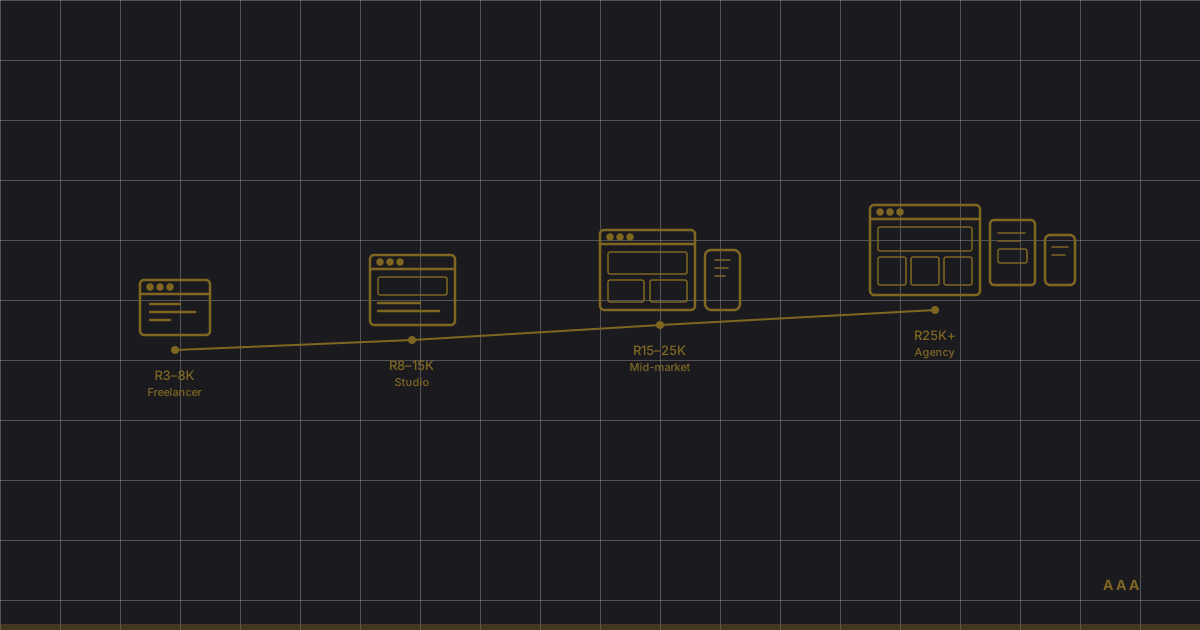
The most common question I get from Cape Town business owners isn't about AI. It's about websites. Specifically: "How much should I actually be paying for this?"
The answer is frustrating because it depends. But most businesses don't need the answer to depend — they need a straight breakdown of what things cost and what they're getting at each price point. That's what this post is.
I'm a CA(SA) turned AI consultant who's audited 50+ Cape Town business websites and rebuilt a number of them. I've seen what agencies charge, what freelancers deliver, and where most businesses end up overpaying for things they don't need — or underpaying for things they do.
The real price ranges in Cape Town
Here's what you'll actually encounter when you start getting quotes in Cape Town. These aren't theoretical ranges — they're what businesses are being charged right now.
Freelancers and solo developers: R3,000–R8,000
This gets you a functional website. Usually 3–5 pages, built on WordPress or a template-based platform, with a contact form and basic mobile responsiveness. A good freelancer will deliver something clean and professional. A bad one will hand you a template with your logo swapped in and call it custom.
What to expect: Working website in 1–2 weeks. Limited revisions. You'll likely need to manage your own hosting, domain, and ongoing updates. If the freelancer disappears — and some do — you'll need someone else to pick up the code.
Best for: Businesses that need a web presence quickly and cheaply. Service businesses where the website is essentially a digital business card.
Small agencies and studios: R8,000–R15,000
This is where most Cape Town small businesses end up. You get custom design (not just a template), responsive development, basic SEO setup, and usually a few rounds of revisions. Some studios include a content management system so you can update text and images yourself.
What to expect: 2–4 weeks delivery. A dedicated project manager or at least a single point of contact. The design will be tailored to your brand, not a generic template. Most agencies at this level build on WordPress, Webflow, or similar platforms. That's not a red flag — W3Techs measures WordPress running 41.5% of all websites, so you'll never struggle to find someone else who can maintain it if the relationship ends.
Best for: Businesses that need something professional and are willing to invest a bit more for design quality and a smoother process.
Mid-market agencies: R15,000–R25,000
At this level you're getting a properly designed website with strategic thinking built in. The agency will ask about your business goals, your target audience, and your conversion funnel before writing a single line of code. You'll get custom copywriting (or at least copy editing), professional photography direction, and integration with your CRM or booking system.
What to expect: 4–8 weeks delivery. A discovery phase before design starts. Multiple design concepts to choose from. Proper testing across devices. Post-launch support for a defined period.
Best for: Businesses where the website is a primary revenue driver — e-commerce, professional services firms generating leads online, hospitality businesses taking bookings.
Established agencies: R25,000–R50,000+
Agencies like Gridweb, which charges R25,000+, and SME Rocket, which averages around R11,500 but goes higher for custom work, operate at this level. You're paying for a brand, a process, and a guarantee. These agencies have dedicated teams — strategist, designer, developer, project manager — and they produce work that's genuinely distinctive.
What to expect: 6–12 weeks delivery. A thorough brand and content strategy. Custom illustrations or photography. Advanced functionality (e-commerce, member portals, API integrations). Ongoing retainer options for maintenance and growth.
Best for: Businesses with a meaningful marketing budget that need a website to compete at the top of their market. Established companies rebranding or launching new product lines.
What you're actually paying for
The price difference between a R5,000 website and a R30,000 website isn't ten times the quality. It's usually three things — and none of them show up in an automated quality check, which is why a build can pass 126 checks and still be broken:
1. Strategy time. A cheap website starts with "what pages do you want?" An expensive one starts with "what are you trying to achieve?" That strategic discovery phase — understanding your customers, mapping your conversion funnel, researching your competitors — takes 10–20 hours of senior time before any design work begins.
2. Design depth. Template customisation takes a day. Original design takes a week or more. The visual gap is real, but it only matters if your customers judge you on design (hospitality, creative industries, luxury services). For many businesses, a clean template is perfectly fine.
3. Post-launch support. Cheap websites are delivered and done. Expensive ones come with a maintenance plan — security updates, content changes, performance monitoring, analytics review. The irony is that most businesses need ongoing support but budget for it least.
The hidden costs most businesses miss
The quote you get isn't the total cost. Budget for these as well:
Domain and hosting: R500–R2,000/year depending on whether you use shared hosting or a managed platform. Don't let your agency own your domain — always register it yourself.
SSL certificate: Usually free now (Let's Encrypt), but some agencies still charge for it. Don't pay for something that's free. Let's Encrypt is a nonprofit providing free TLS certificates to more than 700 million websites — if an agency line-items an SSL certificate, ask what exactly you're paying for.
Content creation: Many agencies quote for design and development but assume you'll provide the copy, photos, and videos. Professional copywriting adds R3,000–R8,000. Stock photography is cheap (R500–R1,500) but custom photography costs R3,000–R10,000 per session.
Ongoing maintenance: R500–R2,500/month for updates, backups, security patches, and minor content changes. If you skip this, expect problems within a year — especially on WordPress, where plugin and security updates are constant. Patchstack's security researchers logged 7,966 new WordPress vulnerabilities in 2024 — about 22 a day — and 96% of them were in plugins, which is exactly the layer an unmaintained site never patches.
SEO and marketing: A website nobody finds is a website that doesn't exist. Basic SEO setup should be included in any build over R10,000. Ongoing SEO work is a separate cost — typically R3,000–R10,000/month.
Performance remediation: The cheapest builds are usually the slowest, and speed is now a measurable, published standard rather than a matter of taste. Google's Core Web Vitals thresholds are Largest Contentful Paint under 2.5 seconds, Interaction to Next Paint under 200 milliseconds, and Cumulative Layout Shift under 0.1 — and the bar is that "tools that assess Core Web Vitals compliance should consider a page passing if it meets the recommended targets at the 75th percentile." Ask for those three numbers before you sign off on a build, not after. Fixing them later is a second project. The same goes for accessibility, which cheap builds almost always skip: WebAIM's 2026 analysis of the top one million home pages found 95.9% had detectable WCAG failures, at "an average of 56.1 errors per page."
The AI factor: why websites are getting cheaper
Here's the part most agencies won't tell you: AI has fundamentally changed the economics of website development. What used to take a designer a week can now be done in a day. What used to require a developer and a designer can now be handled by one person with the right tools.
This doesn't mean the R25,000 website is now worthless — it means the R5,000–R10,000 website is now much better than it was two years ago. AI-assisted development means faster builds, more consistent quality, and lower costs for standard business websites.
The Cape Town market is adjusting. Established agencies have moved upmarket (Gridweb at R25,000+, SME Rocket averaging R11,500+), leaving the sub-R15,000 segment increasingly open. That's where the value is right now for most small businesses.
How to decide what you need
Ask yourself three questions:
1. Is my website a cost centre or a revenue driver? If it's essentially a digital business card (people Google you, check you're legitimate, then call), spend R3,000–R8,000. If your website is supposed to generate leads, take bookings, or sell products, invest R10,000–R25,000.
2. Do I need it to be distinctive? If you're in a competitive market where visual identity matters (hospitality, design, real estate), pay for custom design. If you're a plumber, accountant, or mechanic, a clean professional template is fine. Nobody chooses their mechanic based on parallax scrolling. Jakob Nielsen made this point decades ago with his law of the internet user experience: "Users spend most of their time on other sites. This means that users prefer your site to work the same way as all the other sites they already know." Familiar beats fancy for most businesses.
3. Can I maintain it myself? If no, budget for maintenance. A website that breaks six months after launch and stays broken is worse than no website at all.
What I'd recommend for most Cape Town small businesses
For most businesses I work with, the sweet spot is R5,000–R16,000. That gets you a properly designed, mobile-optimised website with basic SEO, a content management system, and enough customisation to look professional without paying for features you'll never use.
If your current website is actively hurting your business — slow loading, not mobile-friendly, missing basic information, or invisible to search engines — a free website audit will show you exactly what needs fixing. Sometimes the answer is a full rebuild. Sometimes it's a weekend's worth of targeted fixes.
If you're starting from scratch or need a complete rebuild, get in touch. I'll give you an honest assessment of what you need and what it should cost — whether or not we end up working together.
Frequently Asked Questions
How much does a basic business website cost in Cape Town?
A basic 3–5 page business website costs between R3,000 and R15,000 depending on whether you use a freelancer or a studio. For most small businesses, the R5,000–R10,000 range delivers the best value — professional enough to build trust, affordable enough to not drain your marketing budget.
How long does a website build take?
Freelancers and template-based builds take 1–2 weeks. Custom agency builds take 4–8 weeks. The biggest delays are almost never technical — they're waiting for content (your photos, your copy, your feedback on designs). Have your content ready before the project starts.
Should I hire a freelancer or an agency?
Freelancers are best if your needs are straightforward, your budget is tight, and you can manage the project yourself. Agencies are better when you need strategic guidance, custom design, or ongoing support. The R5,000–R15,000 range has competent options in both categories in Cape Town.
What's the ROI on a website investment?
72% of South African e-commerce happens on mobile (DataReportal). If your website isn't mobile-optimised, you're losing a measurable share of potential customers. Statcounter puts mobile at just over 60% of South African web traffic as of mid-2026, against roughly 39% for desktop — the majority of your visitors will meet the phone version of your site first. For service businesses, a well-optimised website with clear calls to action typically pays for itself within 3–6 months through increased enquiries alone.
Do I need to pay for SEO separately?
Basic SEO (proper page titles, meta descriptions, clean URL structure, mobile optimisation, site speed) should be included in any professional build. Ongoing SEO — content creation, link building, local directory management, Google Business Profile optimisation — is separate and typically costs R3,000–R10,000/month. Don't pay for ongoing SEO until your website is fundamentally sound.
What about AI website builders — should I just use one of those?
AI website builders (like Wix ADI, Hostinger AI, or the newer tools coming out of GITEX Africa 2026) can produce a functional website in minutes. The output is improving fast. But "functional" isn't the same as "effective." These tools handle layout and basic content, but they don't understand your business, your customers, or your competitive positioning. For a quick web presence, they're fine. For a website that's supposed to generate revenue, you'll want human strategy behind the technology.
Matt Owen is a CA(SA) and CFA Level 1 candidate based in Cape Town, specialising in AI strategy and implementation for mid-market businesses. He runs Auto Alpha Advisory, which helps South African businesses figure out where AI actually makes sense — and where it doesn't.